
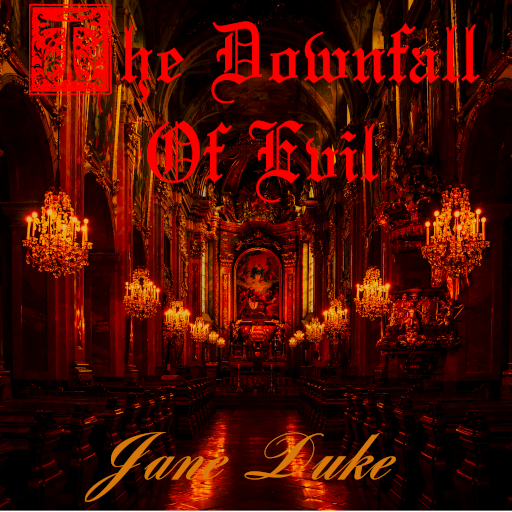
About the Album
The Downfall Of Evil is Jane Duke's second symphonic work. This is an original symphony in B minor, in two symmetrical movements of 16 minutes long each.
I - Concerto Du Sacrifice
The first movement of this work, titled "Concerto Du Sacrifice" is a Romantic concerto for violin and strings, written with baroque counterpoint and vocabulary. This movement is an Allegro Furioso, of a hybrid form between Chaconne and Sonata forms. It starts in A minor, the A and B themes are exposed. Then, it modulates in D minor, A and B themes are repeated, then a C theme is introduced, raises the dramatic tension, and announces the soloist is about to unleash great virtuosity, this is a pre-development section. After a few very virtuosic passages, the movement modulates in B minor, which raises the dramatic tension even more. A and B themes are repeated, then the C theme announces the development section. Once the development section is over, the movement modulates back to A minor, for the recapitulation section. A and B themes are repeated, then the piece modulates in D minor, A and B themes are repeated again, then C theme announces the end of the movement is approaching. The soloist unleashes a few virtuosic passages, then the piece modulates in B minor, and this time, there are no repetition of A and B themes. The final transition from D minor to B minor, is a continuous technical and musical challenge for the soloist. The movement ends in B minor by bringing back the most virtuosic passages of the development section, in a different order.
II - Chaconne in B minor - The Final Judgement
The second movement, is a very intense piece for the whole orchestra. It is of a hybrid form between Chaconne, Fugue, and Sonata forms. It stays in B minor the whole length of the movement. This movement is played at a presto tempo, and is played between mezzo-forte and fortissimo almost the whole length of it. Every single instrumental part of this movement is virtuosic. No part of this movement is easy to play, and every musician gets to play something interesting at all times. This is a true challenge for the whole orchestra, and it is very rich in terms of counterpoint.